Curatorial Statement
In The Beginning
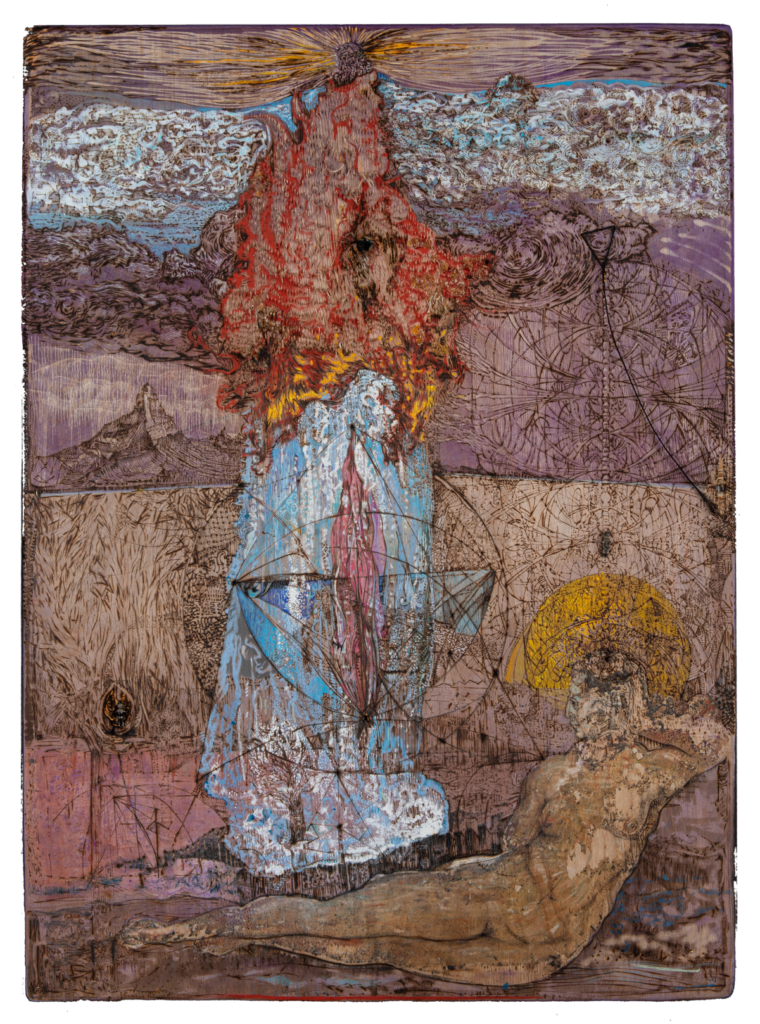
A godhead crowns the composition, radiating yellow light above a band of turbulent clouds rendered in swirling pyrographic marks. The rays push upward and outward, a solar burst at the apex of a vertical cosmology that descends through fire, water, flesh, and geometry into a reclining earthbound body. The head sits atop a massive red form, a pig or beast whose features blur between the monstrous and the divine. The creature’s skull is engulfed in flame. Reds and yellows tear across the wood grain in thick, aggressive strokes. And yet water pours from the same source. A cascade of pale blue and white streams downward through the centre of the panel, carrying the composition’s central axis from heaven to earth.
The Opening
Within the waterfall, a vaginal aperture opens. The form floats inside a vessel, a shallow bowl that holds the water and simultaneously transforms into a fish. The metamorphosis is seamless. Milo’s line work, burned and carved directly into the wooden surface, allows one shape to become another without interruption. Bowl becomes fish becomes geometric lattice. The eye that follows this transformation finds itself pulled into a web of interlocking angles and arcs that spreads across the entire panel like a nervous system made visible.
The Bound Figures
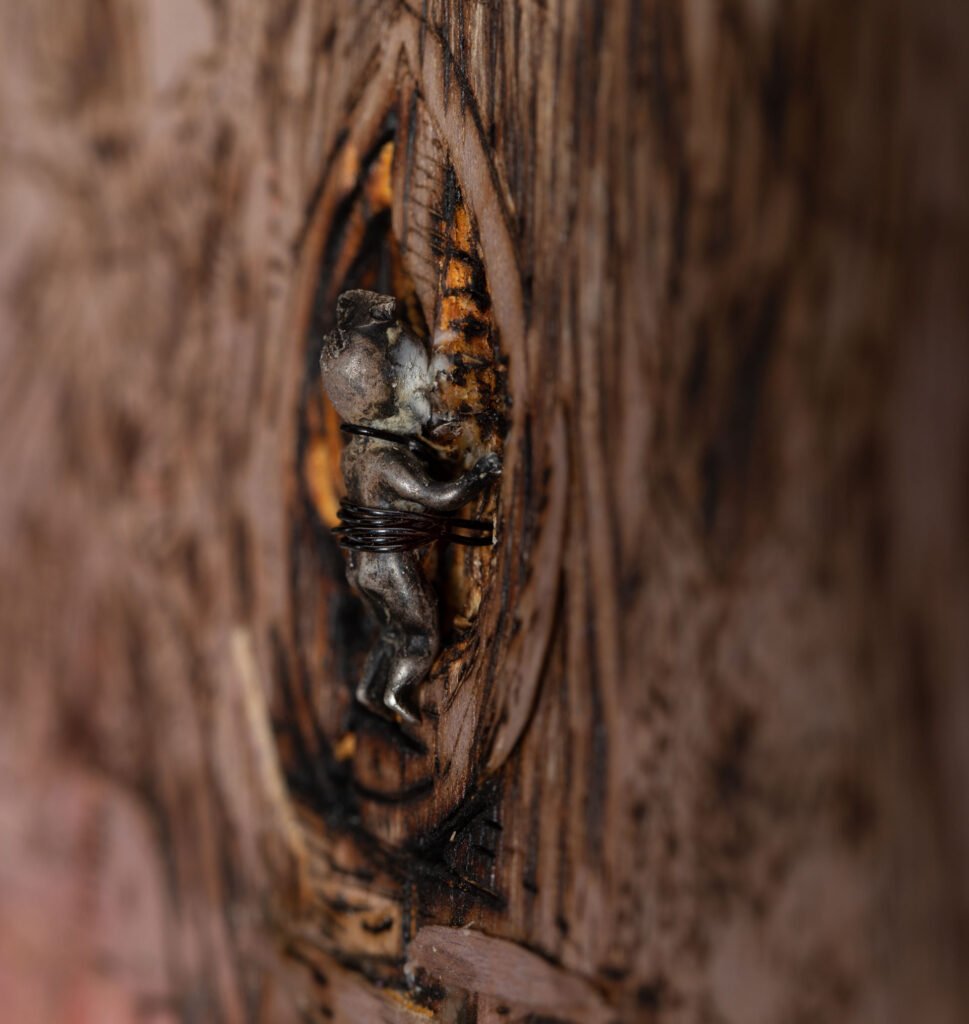
Two small bronze figures are embedded in the wood itself. One faces inward, pressed into a cavity carved to receive it, peering into what reads as a cave or wound in the material. The other faces outward, suspended on a length of black cord that arcs across a field of dense geometric patterning. The babies are cast, weathered, darkened by oxidation. Gold rings clasp their arms. Their placement is both tender and disturbing. They belong to the wood the way fossils belong to stone, pressed there by forces that exceed the artist’s conscious intention.
Devine Feminine
Below this cosmological theatre, a female nude reclines along the lower edge of the panel. Her head erupts into a golden halo that bleeds outward into the geometric scaffolding connecting every element above her. She is the ground from which the entire vision rises. Her body anchors the composition while her consciousness, symbolized by the radiant aureole, merges with the architecture of the sacred.
The Material World
The materiality of the work demands attention. Milo has built the image through an accumulation of processes that would typically belong to separate disciplines. Pyrographic drawing produces the intricate linework, the obsessive hatching and cross-hatching that covers nearly every surface. Gouache paint is applied in passages of saturated colour, reds and blues and yellows that read as elemental forces. The wood itself has been carved, gouged, and excavated to receive the bronze figures and to create topographic variation across the surface. Fine black wire binds one figure to the panel. The grain of the panel remains visible throughout, its natural patterns absorbed into the drawn and painted imagery until the boundary between found texture and made mark dissolves entirely.
Tradition
Godclit belongs to a tradition of devotional panels that stretches back through Northern Renaissance altarpieces and Byzantine icon painting, though Milo’s iconography refuses any single theological framework. The descending axis, from solar godhead through monstrous intermediary to earthly body, echoes Neoplatonic cosmologies of emanation. The alchemical stages are present: the nigredo of the charred and blackened surfaces, the albedo of the streaming water, the rubedo of the flaming beast. Hindu and Buddhist imagery enters through the mandala-like geometric structures and the meditative density of the mark-making. The vaginal symbol at the centre of the waterfall invokes the yoni, the generative source, the sacred feminine from which creation pours forth.
Active Imagination
The work’s title fuses the sacred and the profane with characteristic directness. Milo has described the piece as one that emerged largely beyond conscious control, surfacing through a process aligned with Jungian Active Imagination. “I don’t remember making any of it,” he has written. The composition arrived through sustained contact between hand and surface over an extended period. The panel served first as a working tabletop before the image emerged. What began as incidental mark-making crossed a threshold into involuntary vision.
Structure
Every element in the composition depends on what surrounds it. The mountains carry geometry within their forms. The clouds are built from the same spiralling vocabulary as the vortex patterns lower in the composition. The fish echoes the bowl echoes the vaginal form echoes the waterfall echoes the beast. Milo has constructed an image where no single element can be isolated from the whole. The connectedness is structural. Each shape is held in place by the shapes adjacent to it, producing a visual field that functions like a living organism, every part sustaining every other part in a state of dynamic equilibrium.
Pratityasamutpada
This interdependence mirrors the philosophical commitments that run through Milo’s broader practice. The Buddhist concept of dependent origination, Pratityasamutpada, holds that nothing exists independently. Everything arises in relation to everything else. Godclit gives this principle visible form. The work also enacts the Jungian process of individuation, the integration of all psychic contents, including the monstrous, the erotic, the sacred, and the infantile, into a single coherent field. The bronze babies, the reclining anima figure, the flaming beast-god, and the geometric armature that binds them all together constitute a map of the psyche rendered in wood, metal, fire, and dust.
Becoming
The panel remains, by the artist’s account, unfinished. New forms continue to surface within its layered topography. Godclit exists in a state of perpetual becoming, consistent with the central principle of Milo’s practice: that completion is a form of death, and the living artwork must remain open to revision, addition, and transformation. The wood will continue to age. The bronze will continue to oxidize. The image will continue to shift.